
Pūkoro, our learning management system and home to our e-learning resources, will be unavailable on Wednesday 28 October from 9am to 1pm while we carry out an upgrade.
Building alcohol and other drugs knowledge to reduce restrictive practices
Reducing restrictive practices in inpatient mental health services
About this resource suite
Building alcohol or other drug (AOD) knowledge is a practical, evidence-informed suite of resources designed to strengthen kaimahi capability in responding safely, confidently, and respectfully to tāngata whai ora experiencing AOD use, intoxication, or withdrawal in inpatient mental health settings.
The suite supports services across Aotearoa to:
- reduce the use of restrictive practices
- build culturally safe, mana-enhancing, and trauma-informed environments
- recognise and respond to AOD-related needs
- support wellbeing and safety for tāngata whai ora, whānau, and kaimahi
- strengthen whanaungatanga, partnership, and equity in practice.
Grounded in Te Tiriti o Waitangi and shaped by Māori, Pasifika, clinical, and lived experience expertise, this resource suite focuses on building kaimahi confidence in situations that can otherwise feel stressful or high-risk.
Why this suite was developed
Many tāngata whai ora accessing acute mental health services also experience intoxication, withdrawal, substance related distress, or co existing AOD and mental health challenges. For kaimahi, this can create uncertainty around safety, risk, assessment, and next steps.
Research shows that:
- kaimahi education improves safety, confidence, and care quality
- trauma informed and culturally grounded responses reduce escalation
- AOD literacy significantly reduces the use of restrictive practice.
This suite provides practical tools that support early recognition, de escalation, harm reduction, and whole person responses.
What’s included
The suite includes six e-learning modules plus additional resources to support safe, least restrictive, and AOD informed practice.
E-learning modules
Each module includes evidence summaries, practical scenarios, reflective activities, and short video content.
The modules cover:
- Addressing stigma and discrimination | Te Whakakāhore i te Whakamā me te Tōkeke: Practical strategies, language guides, and scenarios emphasise how stigma contributes to escalation, disengagement, and restrictive responses, and how mana enhancing communication improves safety and connection.
- Diagnostic overshadowing | Te pōhēhē tautuhi: Tools and examples help kaimahi identify when symptoms may be misattributed to substance use, mental health diagnosis, or perceived behaviour, and support more accurate, equitable assessment.
- Safety and wellbeing | Haumaru me te oranga: Guidance on holistic risk assessment, workforce wellbeing, trauma informed practice, and responding to distress without coercion.
- Harm reduction | Whakamitimiti puna mamae: Evidence based harm reduction tips, culturally grounded strategies, and real-world dialogues support safer practice with tāngata whai ora who use substances.
- Screening and assessment | Mōhiotanga me te aromatawai: Clear explanations of when and how to use tools such as AUDIT, ASSIST, CIWA Ar, COWS, SACS, UDS, and clinical observation during intoxication or withdrawal.
- Continuity of care | Te toitūtanga o te manaaki: Guidance on warm handovers, shared care, working with AOD services, emergency services, cultural supports, and whānau-centred models of care.
Note you will need to sign into Pūkoro to access these e‑learning modules.
Additional resources
These tools sit alongside the e learning to support everyday practice; they can be used in any order and combination you find helpful.
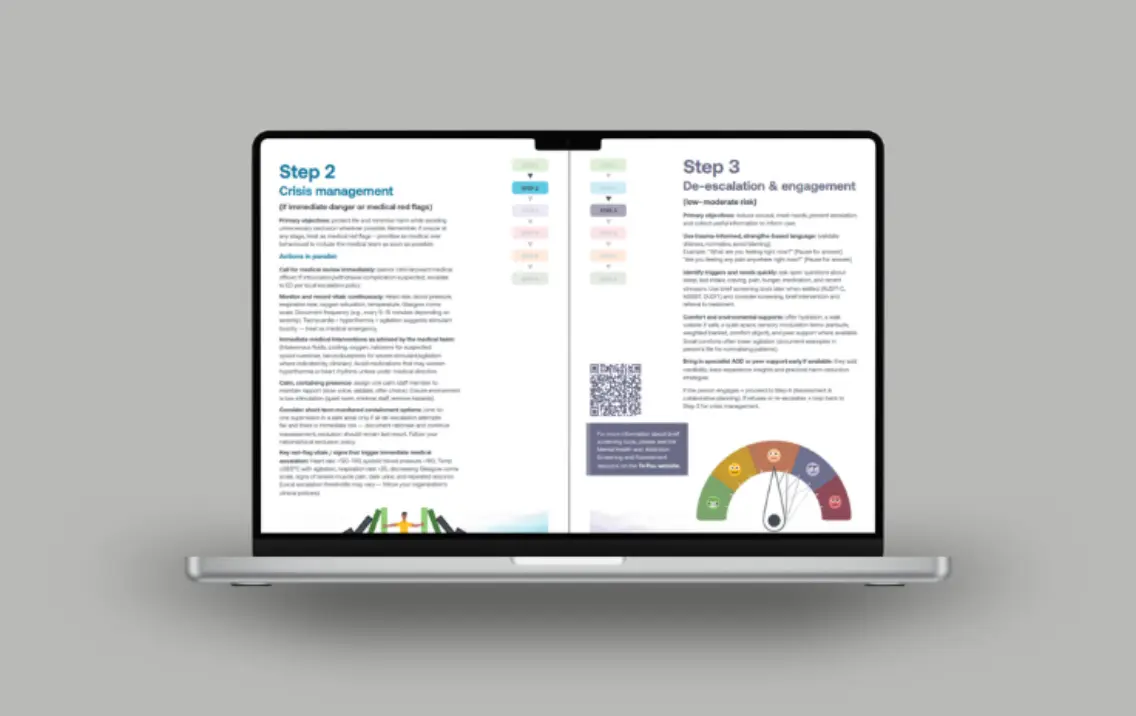
Decision-support flowchart
This decision-support flowchart supports kaimahi to respond safely when a person presents with distress where alcohol or other drug (AOD) use, intoxication, or withdrawal may be involved. It provides a step-by-step guide to safety checks, crisis management, de-escalation, assessment, and least-restrictive care. It is designed to complement existing clinical policies and escalation pathways while supporting trauma-informed and culturally responsive practice.
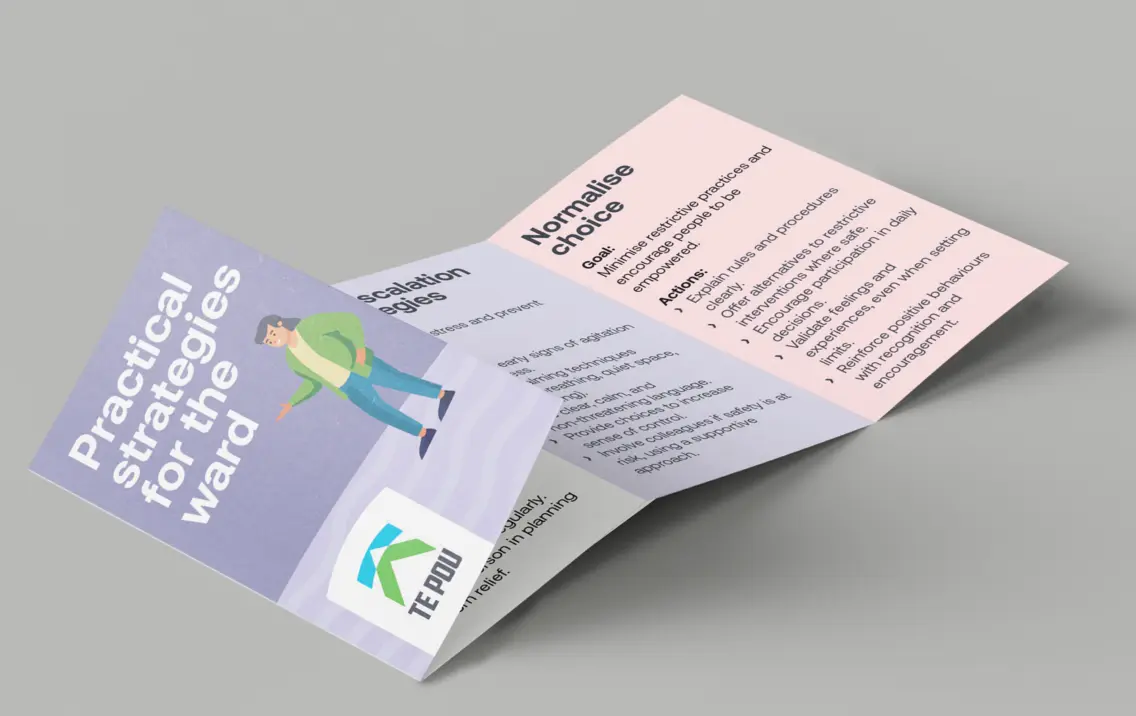
Practical strategies for the ward
These practical ward-based strategies are designed to support safe, compassionate, and person-centred care from the moment someone is admitted. Each card offers clear goals and simple, effective actions that kaimahi can use in everyday practice—whether it’s building trust early, anticipating withdrawal, de-escalating distress, supporting informed choice, planning care collaboratively, applying harm-reduction approaches, or strengthening therapeutic relationships.
These cards are downloadable, or hard copies are available through the Te Pou store.
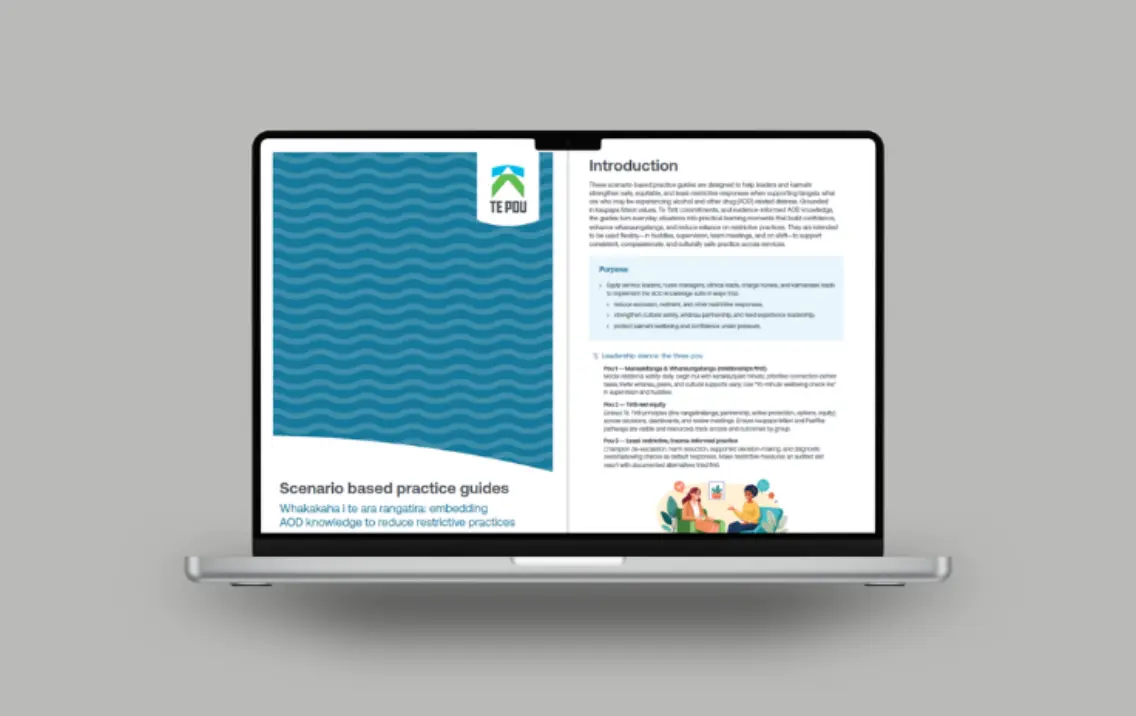
Practice guide for leaders
This practice guide is designed to help leaders and kaimahi strengthen safe, equitable, and least-restrictive responses when supporting tāngata whai ora who may be experiencing alcohol and other drug (AOD) related distress. Grounded in kaupapa Māori values, Te Tiriti commitments, and evidence-informed AOD knowledge, the guide turns everyday situations into practical learning moments that build confidence, enhance whanaungatanga, and reduce reliance on restrictive practices. It is intended to be used flexibly - in team huddles, supervision, team meetings, and shifts - to support consistent, compassionate, and culturally safe practice across services.
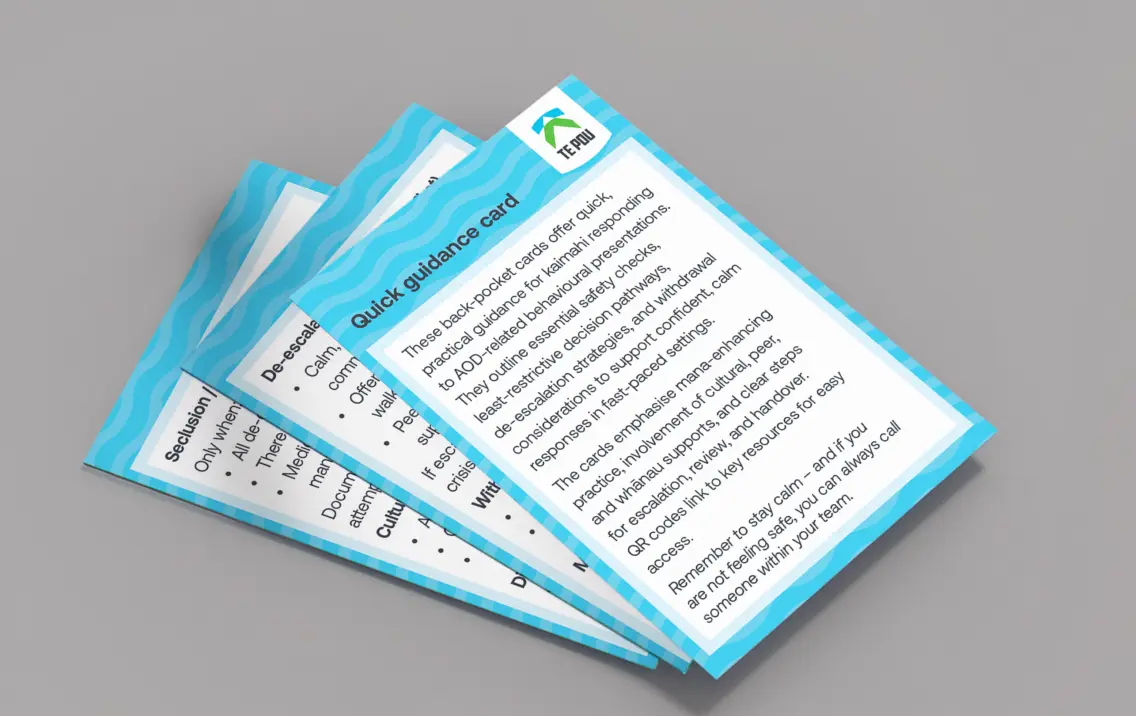
Quick guidance cards
This resource offers quick, practical guidance for kaimahi responding to AOD-related behavioural presentations. They outline essential safety checks, least restrictive decision pathways, de-escalation strategies, and withdrawal considerations to support confident, calm responses in fast paced settings.
The resource emphasises mana enhancing practice, involvement of cultural, peer, and whānau supports, and clear steps for escalation, review, and handover. QR codes link to key resources for easy access.
These cards are downloadable, and hard copies are available through the Te Pou store.
Introductory short video series
This short video series has been created to support kaimahi across the mental health sector to build confidence, compassion, and safety in everyday practice. Each video offers a practical scenario grounded in real world challenges such as stigma, cultural safety, de-escalation, and harm reduction showing what mana enhancing, least restrictive practice looks like in action. These bite-sized resources are designed to spark reflection, strengthen skills, and reinforce approaches that uphold the dignity, voice, and wellbeing of tāngata whai ora and their whānau.

Resources
Te Pou has a wide range of evidence-based resources and tools to help the addiction and mental health workforce.
Learn MoreOur work
Te Pou works alongside addiction and mental health services to understand their priorities and workforce challenges.
Learn More